
Accelerated AI Delivery (AAID)
The Software Lifecycle, Redesigned for AI-Era Speed
We rework the entire delivery chain, every handoff, gate, and feedback loop, so intelligence compounds velocity across every sprint instead of just boosting individual productivity.
Common Friction Points
- Requirements lose meaning in translation
- Review cycles bottleneck on senior engineers
- Testing catches problems too late
- Deployment relies on tribal knowledge
What AAID Solves
- AI-assisted specification that stays coherent
- Async, AI-augmented code review at scale
- Shift-left testing with AI-generated coverage
- Self-documenting, intelligent pipelines

Measure cycle time and rework against your real data.

Tooling matched to your actual stack, not a generic bundle.

Explicit, AI-assisted contracts between delivery phases.

Prompt libraries and review standards become engineering culture.

Baselines tracked and reviewed every quarter.
Core Capabilities
Core Capabilities Across the Delivery Lifecycle
AI-Assisted Specification
Structured requirement templates with AI validation so business intent survives translation into buildable engineering stories.
Intelligent Code Review
AI pre-screens pull requests for security, complexity, and pattern violations before human reviewers engage.
Continuous Test Intelligence
Coverage-gap analysis and AI-generated edge cases prioritize testing by consequence, not coverage percentage.
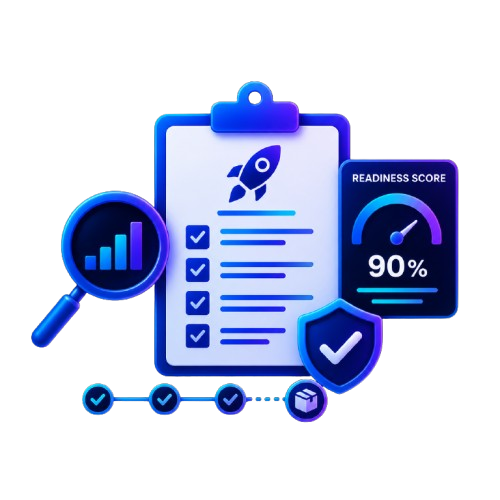
Release Readiness Analysis
AI surfaces risk signal from code history and past incidents before every deployment window.

Post-Deploy Learning Loops
Observability data feeds back into the SDLC so teams see the downstream effect of upstream decisions.
Engineering Knowledge Capture
Decisions and rationale captured automatically so institutional knowledge outlasts turnover.
In one recent engagement, a vertical SaaS company’s review queue was the real bottleneck, not their engineers’ output. We put an AI-augmented review step ahead of human review that caught the mechanical issues (missing tests, obvious security gaps, style violations) automatically, so the human reviewers only saw pull requests that were actually ready for a design conversation. Their median time-to-merge dropped from just under two days to about four hours.
Contact Us
Let's Talk About What You're Actually Trying to Ship
No vendor deck, no pitch. Tell us the problem and we’ll give you a straight answer about whether and how we can help.